
Dvanta Technologies insight
Article overview
SSR performance can have a direct impact on the first-page experience of an enterprise commerce application.
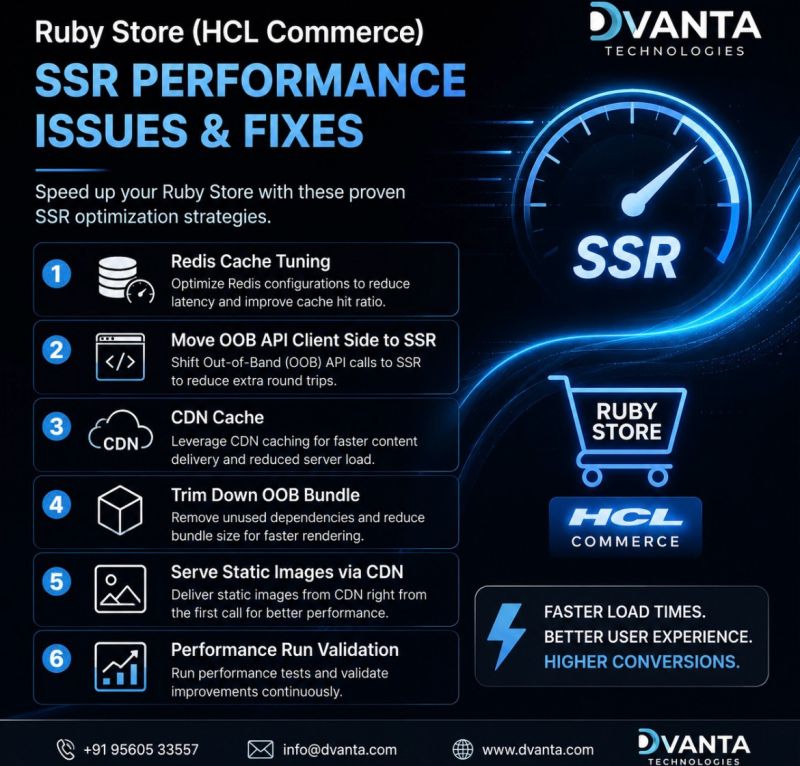
For a Ruby Store running on HCL Commerce, we addressed key performance bottlenecks through focused optimization:
- 1
Redis Cache Tuning
Optimized Redis caching to reduce latency and improve cache-hit performance.
- 1
Move OOB API Calls to SSR
Moved selected Out-of-Box API calls from the client side to SSR, reducing unnecessary browser round trips.
- 1
CDN Caching
Leveraged CDN caching for faster content delivery and reduced origin-server load.
- 1
Trim Down OOB Bundle
Removed unnecessary dependencies and reduced bundle size for faster rendering.
- 1
Serve Static Images via CDN
Delivered static images through the CDN from the first call to eliminate avoidable application-server latency.
- 1
Performance Run & Validation
Ran performance tests before and after optimization to validate improvements and identify further bottlenecks.
The goal isn't just adding more servers. It's about removing the right bottlenecks.
At Dvanta Technologies, we help enterprises optimize, modernize and engineer high-performance HCL Commerce platforms — from SSR and API optimization to CDN, caching, cloud and production performance engineering.
Faster Load Times. Better User Experience. Higher Conversions.